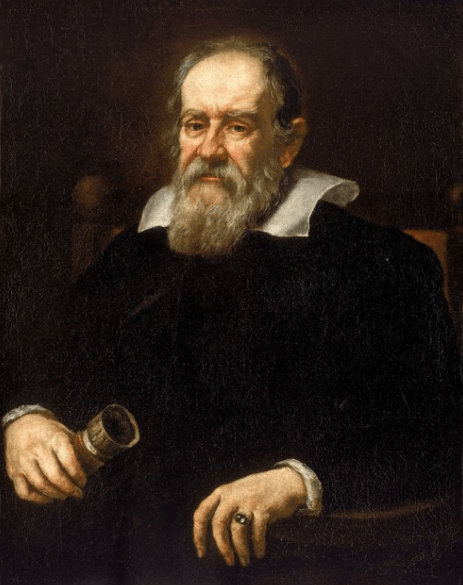
Source: Wikipedia
My initial impression of Galileo was that he was an astronomer, a physicist, and a man who stood up against the Church to defend his observations despite the attacks he endured. After some research into his life, I discovered that Galileo Galilei was much more than that — and, in certain respects, less.
Galileo and Mathematics
“Philosophy is written in this grand book, the universe, which stands continually open to our gaze. But the book cannot be understood unless one first learns to comprehend the language and read the characters in which it is written. It is written in the language of mathematics, and its characters are triangles, circles, and other geometric figures without which it is humanly impossible to understand a single word of it; without these one is wandering in a dark labyrinth.”
— Galileo Galilei
Galileo’s contributions to mathematics appear to be more philosophical and conceptual than concrete and technical. He held a chair in mathematics at the University of Padua and produced one of the most famous declarations about the role of mathematics in understanding the natural world. Yet I had considerable trouble finding evidence of his actual technical contributions to the discipline. He may, in fact, have lacked the necessary mathematical ability.
His scientific contributions to physics and astronomy are undeniable, but the mathematical reasoning within those arguments can indeed be questioned. In the case of the cycloid, for example, Galileo relied on an experimental approach rather than rigorous mathematical proof: he cut the shape out of paper and gathered that the area under the cycloid was somewhere near — but not accurately — three times the area of the generating circle. There is a reason, as Huygens argued, why geometric proofs are preferred to experiments:
“Do not think that I am relying on experiments, because I know they are deceitful.”
— Christiaan Huygens
Furthermore, Galileo has received high praise for his discovery of the law of free fall, but he appears to have applied it incorrectly in several important cases. He erroneously argued that the orbital speeds of the planets are equal to the speeds they would have acquired through free fall from a common height. He also mistakenly calculated the path of falling objects in a reference frame that does not rotate with the Earth.
These oversights lead me to believe that, rather than a proper mathematician, Galileo was a far better philosopher. His deepest ambition was not to solve equations but to find a unified theory of matter — to understand the architecture of the natural world, even if the technical tools available to him were not always equal to his vision.
Galileo and the Church
“The Book of Nature is written in the language of mathematics.”
— Galileo Galilei
“The Bible was written to show us how to go to heaven, not how the heavens go.”
— Galileo Galilei
Galileo’s relationship with the Church was more ambiguous than the standard narrative suggests. He was funded by the powerful Medici family and was a personal friend of Pope Urban VIII. His adoption of the two-book concept — the Book of Scripture and the Book of Nature — suggests that his faith in the truth of God’s word remained strong. He recognised that God is the creator; nature is the creation.
In his Letter to the Grand Duchess Christina, Galileo argued that there are two truths: one revealed in the Bible, the other inscribed in the natural world. Both are divine and therefore cannot contradict each other. But both require interpretation before their truths can be properly understood. Scripture, he maintained, must accommodate the understanding of common people in order to lead them toward true religion. Creation, meanwhile, must be abstracted from sense experience through scientific inquiry. The two truths are necessarily consistent and compatible; it is only the interpretations that can go awry, and that need correction along the way.
A reasonable guess, then, is that Galileo’s original intention in writing the Dialogue Concerning the Two Chief World Systems was not to wage war against the Church, but to offer an alternative interpretation of Creation. Against the backdrop of the Reformation, the role that history assigned to Galileo — as a bludgeon used to beat the Church — may have been shaped more by what the times needed him to be than by what he intended to be. We tell the story of Galileo the rebel because we needed a rebel. Whether Galileo himself would have recognised that portrait is another question entirely.
Xinyue Cai
September 25, 2022
Categories List
- Letters to Julia (2)
- Lives of Mathematicians (6)
- Speeches (3)
 I Know That I Know Nothing
Leave a comment