I cannot rest from travel; I will drink
Life to the lees. All times I have enjoyed
Greatly, have suffered greatly, both with those
That loved me, and alone.I am a part of all that I have met.
And this gray spirit yearning in desire
To follow knowledge like a sinking star,
Beyond the utmost bound of human thought.The lights begin to twinkle from the rocks;
The long day wanes; the slow moon climbs; the deep
Moans round with many voices. Come, my friends,
‘Tis not too late to seek a newer world.— Alfred, Lord Tennyson, Ulysses
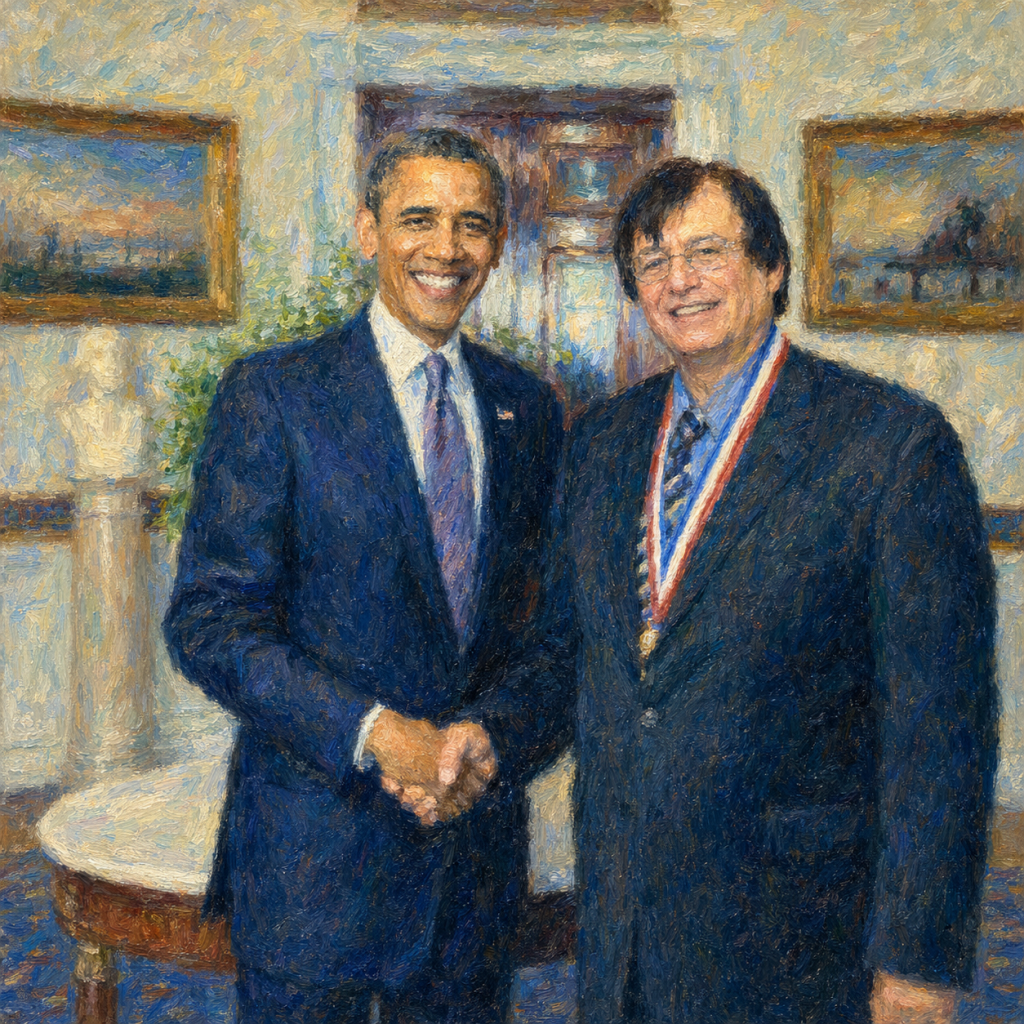
Painting after the photo of Professor Tapia receiving the National Medal of Science from President Obama in 2011, the picture he used as his profile for Zoom meetings and his personal accounts
Professor Richard A. Tapia passed away on May 22, 2026, in Houston.
I took his optimization course, CAAM 560, in the fall of 2022. In the spring of 2023, when I was completely lost about my future, he became something more than a professor to me: he mentored me through the decision of transferring from the economics school to the business school, and then he served as my referee — the person who vouches for you. He did not just help me make the most important choice of my career so far. He guaranteed it, with his own name, at a time when I could not yet guarantee anything about myself.
When I sat down to write this post, I struggled for a long time with what it should be about. His mathematics? His life? He was a world-renowned mathematician and a legendary advocate, and both stories have been told, properly and well, by the people whose job it is to tell them. I have nothing to add there. What I have is smaller: a classroom in the fall of 2022, an office in the spring of 2023, a few phone calls at night.
Then I realized that this is not a compromise. In his class, every week, he assigned us a Mathematician of the Week — not their theorems, but their lives. He wanted us to see the person behind the mathematics, because he believed the two were never separate. So writing about the person I remember, rather than the theorems he proved, is not a smaller version of a tribute. It is his own method, turned back on him.
And there is a reason the method fits him better than most. He had, by any honest account, a hard life. People who have gone through that much tend to go one of two ways. Some put out other people’s fires. He lit them. In everyone who studied with him, worked with him, or simply crossed his path, he left a seed of fire — and those seeds have kept lighting others. There is a phrase for this in Chinese: 生生不息. Life giving rise to life, without end.
The memories are the fire seeds he left in me. This post is one of them, held out to whoever is reading, in the hope that it catches.
Math is a great fantasy
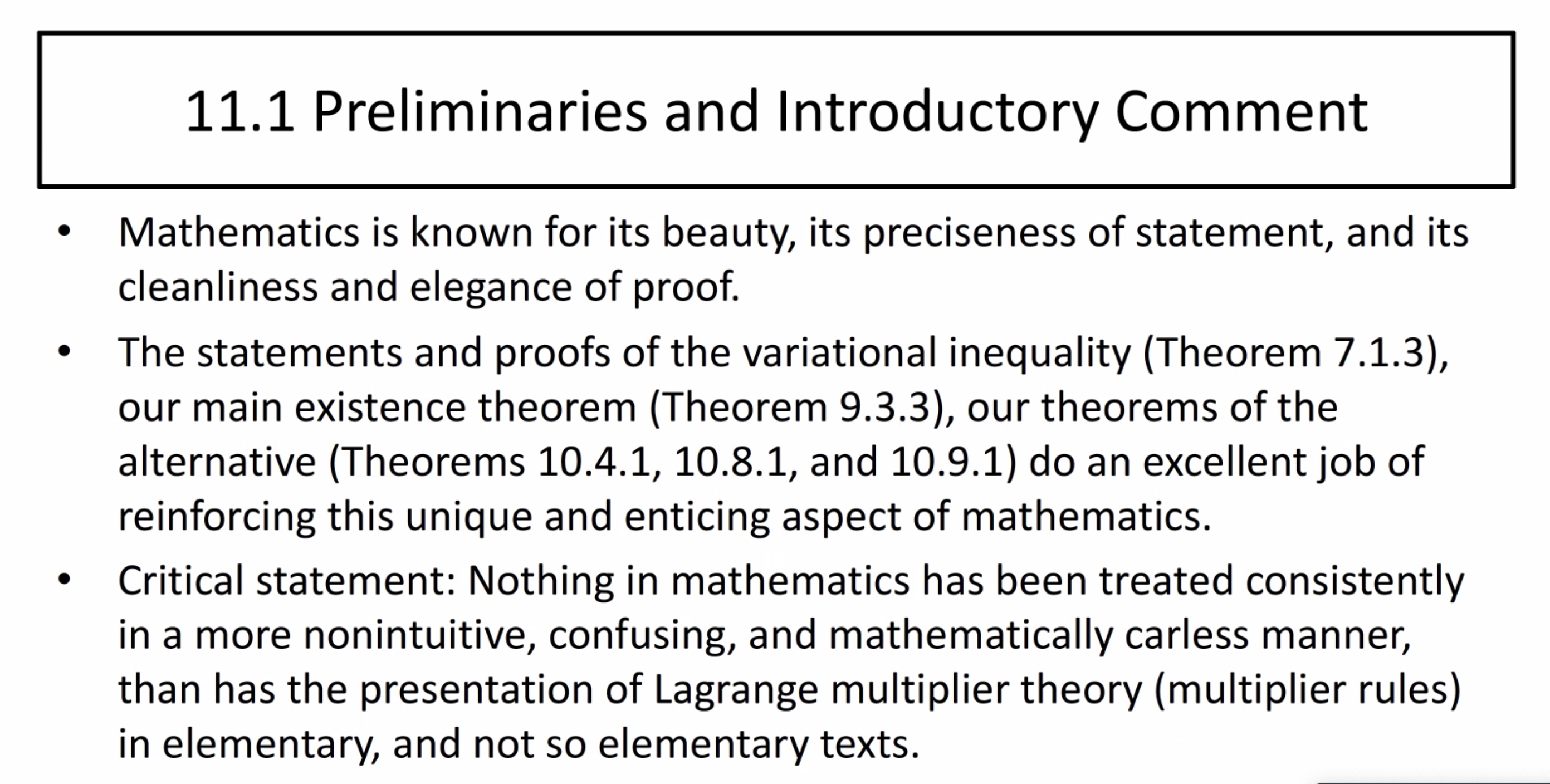
The slide from CAAM 560, fall 2022, “11.1 Preliminaries and Introductory Comment.”
His book on optimization theory — the one our course was built on, the one he spent more than thirty years finishing — opens not with a definition or a theorem, but with a line from Sofia Kovalevskaya: people who have not studied mathematics confuse it with arithmetic and consider it dry, when in truth, she wrote, “this science requires great fantasy.”
Think about who chose that epigraph. A numerical optimizer. A man whose career was Newton’s method, convergence rates, constrained minimization — the least dreamy corner of mathematics, the part that actually has to run on a computer and land on an answer. Of all the words available to summarize his life’s work, he picked fantasy.
The course taught the way that word does. We did not start from definitions. We started from the very beginning — the brachistochrone problem, Bernoulli’s open challenge to the mathematicians of Europe, three hundred years of the calculus of variations, including the part where Galileo got the answer wrong. He insisted on this: if you really want to study something, you trace it back to where it begins. Partly because the beginning is where the fantasy lives — the moment when the theorem was not yet a theorem, just a question someone was bold enough to imagine. But mostly for a harder-headed reason: you cannot make a real contribution to a problem you have only met in its finished form. You have to know where it started and how it got here — every wrong turn, every detour — because that is the only way to see where it is going, and what is still missing. The history was not decoration. It was a map, and he was teaching us to read it so that one day we could extend it.
Which brings me to conjectures and proofs. This is an old argument in mathematics, and mathematicians pick sides. Gauss, famously, dismissed Fermat’s Last Theorem as an isolated proposition of very little interest — he could easily write down a multitude of statements nobody could prove or refute. That is the proof side talking: a conjecture without a proof is just noise. Tapia picked the other side. At the beginning of the course he threw the question at us, and I gave my answer weeks later in my essay on Fermat: conjectures are leaps; proofs are the inspection of the land you have jumped to, and the inspection is only possible because someone got there first. Only later, reading his preface, did I find that we had landed on the same side — for different reasons. Mine was about leaps. His was about creativity: conjecturing a useful theorem, he wrote, is far harder than proving it, because the conjecture is what demands creativity, and “there is no clear path leading to creativity.”
His side of the argument means something to me that I did not say in that essay. My mind moves in leaps. The insight comes first, without any reasoning attached — my intuition simply says go this way — and the reasons arrive on their own schedule, sometimes within hours, sometimes not for years. For most of my life this made me feel less like someone doing mathematics than like someone 跳大神 — a fortune-teller, pronouncing answers she cannot yet justify. Working through someone else’s technical machinery is a different matter: I can do it, but it feels like drills — line after line, correct and joyless — something I force myself through rather than something that moves on its own. Even when I prove, I prove by leaping: drawing case after case until the pattern announces itself, then checking the ground I landed on. And the world rewards the checkpoint, not the leap: rigor gets recognized quickly, while a conjecture can wait decades for its reward, or never receive it at all. So when a man like Tapia — a man whose theorems run on computers — writes that the conjecture is the harder and more creative act, it is not an abstract position to me. It helped me accept the kind of mind I actually have.
And he was still leaping himself. I kept one slide from that fall. It introduces Lagrange multipliers — a topic taught in every economics program on earth — and in the third bullet, he declares that nothing in mathematics has been treated in a more nonintuitive, confusing, and mathematically careless manner than the standard presentation of this theory. He was eighty-three, lecturing on one of the most canonical topics in the field, and he put careless on the slide. He had been a working programmer at IBM in the 1960s, in the computing world von Neumann built — von Neumann’s weak topologies ran through the heart of our course — and yet after sixty years inside the machinery, mathematics was still alive enough for him to pick fights with. That, more than any theorem, is what he taught me mathematics is: not a finished cathedral to be toured, but something you are allowed to find beautiful, find wrong, and argue with.
Global excellence
One day that fall, he presented his own life to us: slides of family photographs, old newspaper clippings, the whole trajectory. This is where I learned what his mother had taught him.
Magda Tapia came from Mexico as a young woman. She never had the chance to finish school. Yet the lesson she gave her sons — the way he told it to us in class — he called global excellence: whatever you do, be the best in the world at it. I don’t know if he ever put it this way himself, but in his own mathematics there is a name for what she was asking. Best in your class, your street, your city — those are local optima. She wanted the global one. And whether or not her lesson had anything to do with his choice of field, he lived by it as if it were a design principle. In his office he once told me that every step of his career had happened not by luck, but by design. The son of the woman who demanded the global optimum spent his life refusing to settle for local ones.
The proof that the family meant it hung there on his slides. As young men in Los Angeles, Richard and his twin brother Bobby built cars and drag raced them — and because they were Tapias, they did not race casually. Their car ran a quarter mile in 6.54 seconds: a world record, recognized by the National Hot Rod Association, reported in the papers whose clippings we were looking at. The brothers went on to be world-class in two rooms that polite society ranks very differently. Bobby kept racing, set world speed records, and entered the NHRA Hall of Fame. Richard went into mathematics and received the National Medal of Science from President Obama.
And here is the part that might surprise you: global excellence, in his hands, was never the same thing as grinding. He wrote about his own student years with total candor: “I studied very little in high school and in community college. At UCLA I picked it up a bit, but never on weekends — I lived in sunny Southern California. At the University of Wisconsin I learned from the best and turned over a new leaf, and I have not let my academic hard work compromise the other important components of my life.” The standard was for what you did, not for how much of your life you surrendered to it.
He gave us the classroom version of the doctrine as explicit advice: sit in the first row. Ask the first question — and make it the best question — so that when the room forgets everything else, it remembers you. That was the mic-drop moment.
Obviously, I didn’t listen. In every class of his, I sat in the corner, and I never once asked the first question. But I have a habit, and I had it in his classroom too: I stay quiet through the whole discussion, and then, at the end, a question jumps out of nowhere — my one piece of drama — and I leave the mic on the floor on my way out. The corner, it turns out, is where I do my leaping from. It took me a long time to understand that I had not disobeyed him. Perhaps his lesson was never really about the first row; that was just his implementation. The lesson was: wherever you sit, be impossible to forget.
Love is love
Jean Rodriguez was a ballet dancer. She married Richard Tapia in 1959, when he was still an undergraduate at UCLA, and they stayed married for sixty-three years.
The two of them loved hosting parties. Jean would bring her dancer friends; he would bring his math friends. The evenings had, by his telling, a reliable structure: by the end of the night, his friends had all fallen in love, while her friends were complaining about the weirdos. I laughed out loud when he told us — the kind of laugh that has a little ache in it.
They dressed up together every Halloween, and always as a pair. One year they went as Greek gods, in white togas with gold belts. Another year they were clowns in matching polka dots. There was a year he was a showman in a bowler hat and she was a bunny girl. And there was a year he wore a pink tutu, a red wig, and ballet shoes, while the actual ballerina in the family stood beside him in a plain dress, laughing.
The costumes did not wait for Halloween, either. Once they dressed as cowboys just to pick their friends up at the airport, and their friends took one look and pretended not to know them.
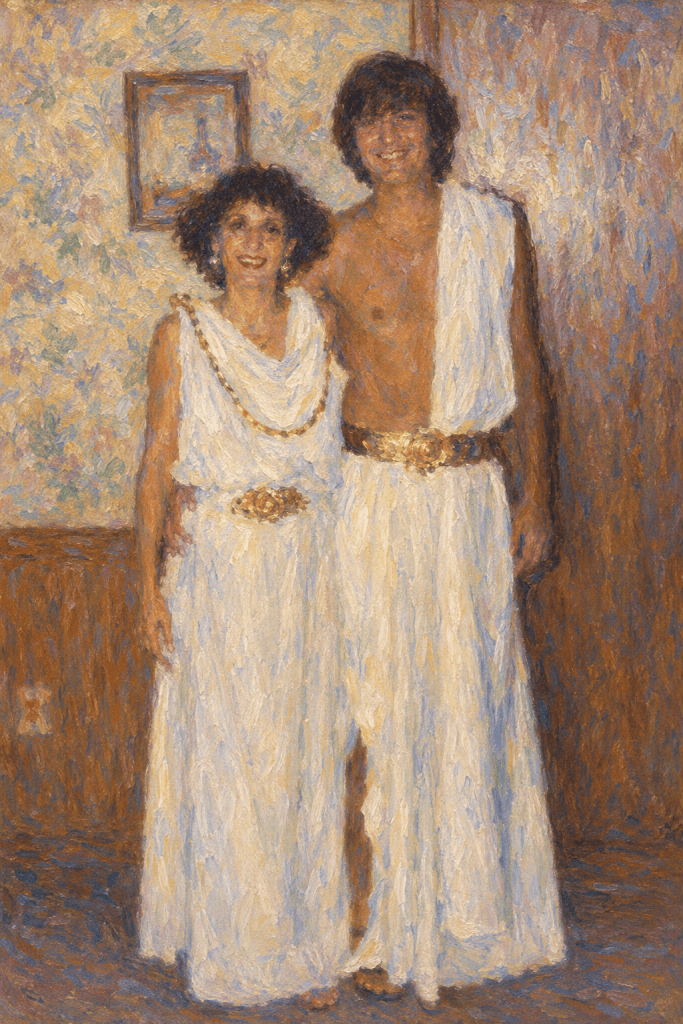
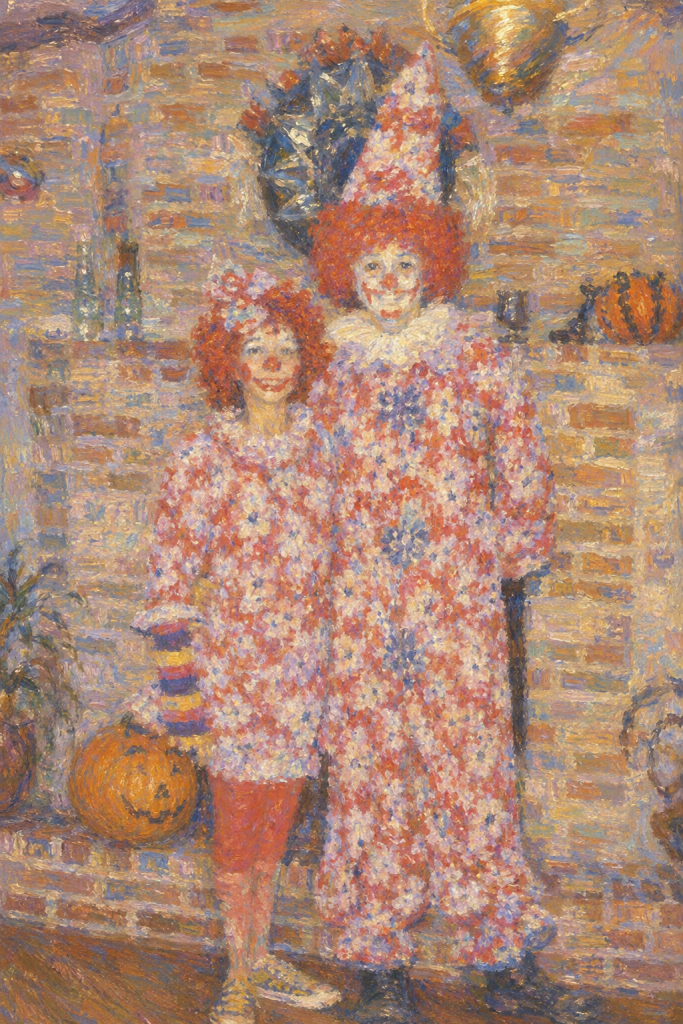
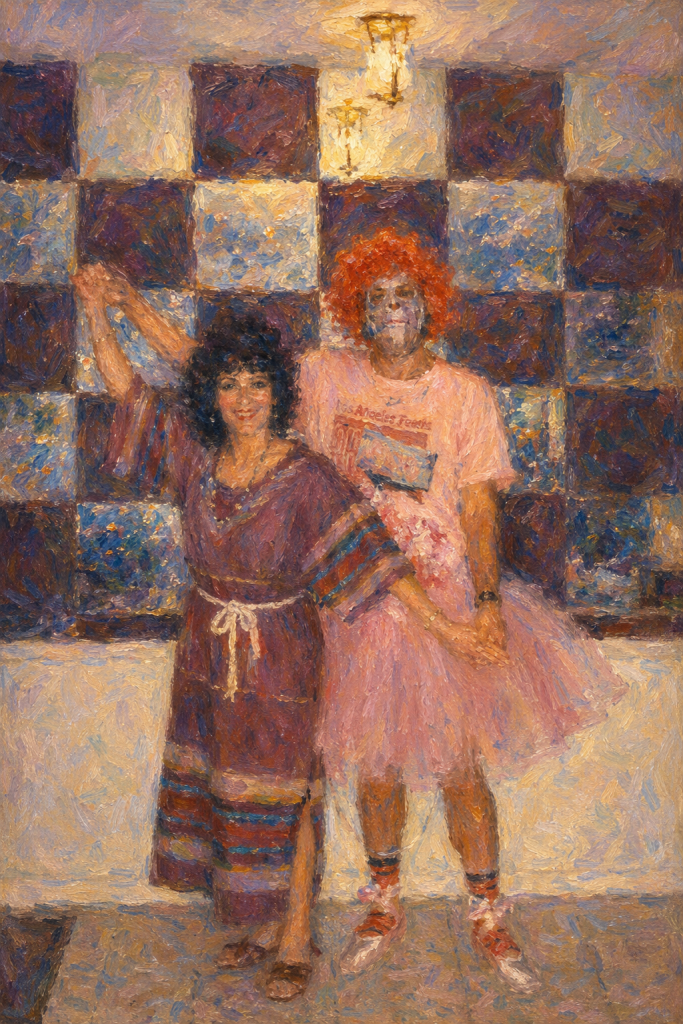
Paintings made from photographs Professor Tapia shared with us in class.
Their oldest daughter, Circee, had followed him from UCLA to Rice. In 1982, she was killed by a drunk driver.
At almost the same time, Jean was diagnosed with multiple sclerosis. She could not dance anymore; her career as a dancer was over. Then he told us what she had said about it: strike three, and I’m out.
He told us this in a controlled voice, with tremendous sadness behind it: she drove her car into the barrier of the road, to feel what her daughter had felt in the last moment. She survived.
After that, he told us, the two of them needed new hobbies — not pastimes, but something in life to hold onto, something that would bear weight when nothing else did.
He went back to cars. He and Jean built a show car together, a 1970 Chevelle they named Heavy Metal, and he took it to car shows across the country. Jean, who could no longer dance, made exercise videos for people in wheelchairs. He played some of them for us in class.
This was the second time a mathematician had said this to me. The first was Florica Cirstea, whose classes in Sydney I had been taking since 2019 — it was in her honors topology class, in the lockdown year, that she told us hobbies are like your old friends: in difficult times, they become the sunshine in your life.
It landed then. Where I grew up, a hobby was something you had to be good at before you could claim it. Florica’s words undid that — Magda Tapia demanded excellence in what you do; Florica released me from needing it in what I love. They are old friends I can keep visiting and going back to, whenever I need.
The Tapias, honestly, are an extreme case. And I find it interesting that both people who taught me this were mathematicians.
Jean was in a wheelchair for nearly four decades. He took her everywhere he went — wherever in the world a conference or a lecture called him, she came. He liked to say she had traveled more than anybody in the country in a wheelchair. When people asked him how he managed it all — the daughter, the illness, the decades — he gave the same answer every time. “I have no choice.”
That fall, Jean was in the hospital. Some days he began class by telling us he might have to answer his phone, because the call might be from the hospital. He visited her every day. She could only eat soft food by then, and he prepared it himself; once he showed us — a banana, and something he had made — and explained what she could and couldn’t have. He sounded worried when he mentioned the phone, tender when he talked about the food, a little irritated when he got to the nurses. And then he taught — the way he always taught, passionate and sharp, and it was still a fun class.
Jean passed away in November 2022. I don’t think I understood, then, what I was watching.
On December 3, 2022, he hosted the end-of-semester party at his house. He had announced it to the class in advance, in a long message that read like a guide to a place he loved: the front yard would be decorated for Christmas — it had won the local Grand Prize two years running; the backyard, he wrote, was “a land of fantasy,” and each item in it had its own story. There would be a carousel. He asked us to spend the first hour walking around, socializing, and riding it, and then we would eat.
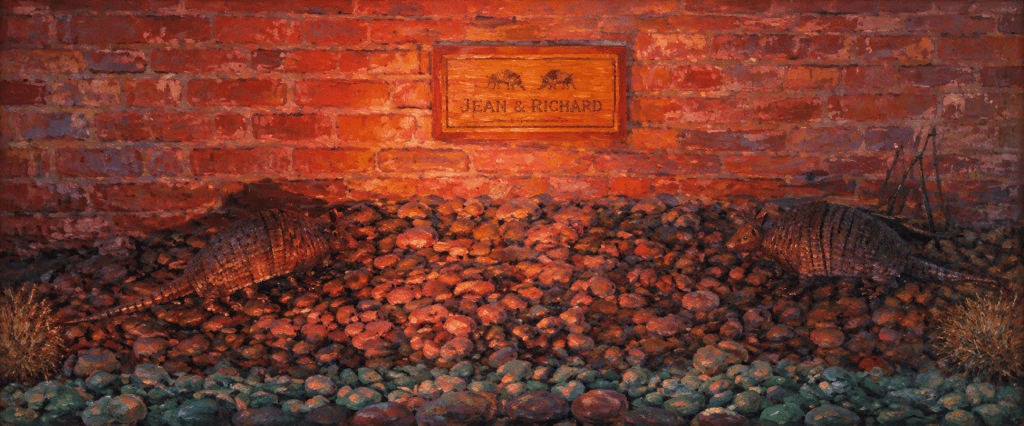
In the backyard: two armadillos and a plaque, Jean & Richard.
We went. We toured the house ourselves, his message in hand, like a treasure hunt — everything had a name, everything had a story, and the backyard really was what he had called it. And we rode the carousel, a class of graduate students going round in his backyard in the December dark, three weeks after Jean died.

December 3, 2022. The front yard, the lights, the carousel.
Paintings from my own photographs, taken at his house that evening.
Let human be human
I was brought into mathematics by Florica Cirstea. It was the fall of 2019, in an advanced analysis class in Sydney, and until then I did not know I could do it at all. She told us that mathematics is a way to communicate — that it is a social activity — and she meant it literally: in her tutorials we were put in groups to write proofs together on whiteboards, and then we presented them, as a group, to the whole class. I understood her partly then. I understood the rest of it later, in Houston.
Then came Tapia’s Mathematician of the Week. Every week he assigned us one — we each wrote about that mathematician’s life and submitted it to him. Not their theorems: their lives. It was the first time I had looked at mathematicians as people rather than at their work. The names attached to the theorems stopped being names. Hausdorff, Fermat, Kovalevskaya, Cantor — they had loved and lost and quarreled and been rejected; they had really been here, in this world, living their lives, just as you and I are living ours. In the textbooks they are results. In that classroom they were alive.
Between Florica’s sentence and Tapia’s assignment, my love for mathematics took its final shape. From her I had the first half: mathematics is a precise and rigorous way to communicate — to say exactly what you mean and be understood exactly — and therefore a way to bond with people. From him I got the second: the people you are bonding with are real, and always were. Put together, mathematics became for me a way to see, and to live, my life. I am obsessed with the beauty of the logic, and I always will be. But that is not the only reason it stayed.
This has had a long-term effect on me, and it is a practical one. Anyone who fell in love with pure mathematics early knows the shape of what usually comes next: at some point most of us turn toward computer science, or finance, or engineering, or, these days, AI. People need to support themselves. When those of us who made that turn talk to one another, there is often a certain wistfulness in it, somewhere. Tapia had watched the same turn for fifty years — graduate students in mathematics, he told me, usually end up in applied math, engineering, or computer science — and he said it plainly, without regret. It was simply how the world worked.
But the wistfulness, I have come to think, comes from believing that mathematics is a job — something you either hold or lose. If it is instead a social activity, a way of communicating and a way of living, then it is embedded in how you talk to the world and how you bond with people; it is in everything. It never leaves you, and you never have to leave it. I have not, and I no longer expect to.
MOW was also the beginning of my non-academic writing — the very beginning of everything: two blogs, the book I am writing, and this post. And the way I write comes from him. His book reads like what I have come to call fireplace talk: he writes as if he were talking to you, and he leaves the thinking in — the detours, the doubts, the questions he asks himself in the middle of a proof: “Did I prove more than I stated? Does this proof lead me to conjecture and prove a more general result?” I write this way because I like how it feels — as if I were talking to you, and you were wandering around in my mind for a while.
Three lessons
In the spring of 2023, I was completely lost about my future. I went to him. We had several conversations in his office, and when I was at my most upset, he let me call him at night — once, maybe twice; I honestly can’t remember, which tells you something about the state I was in.
He gave me clear advice about transferring from the economics school to the business school, and he gave it with a clear line of reasoning. He used the stories of his own children — what they had chosen, and how it had gone — to lay out the principles. Those stories are theirs and not mine to tell. But his conclusion was his, and it was not ambiguous: “Transfer to the business school,” he said, “unless you would die if you are not doing economics.” When I had decided, he wrote the letter. He was my referee. He put his name behind a choice I could not yet fully believe in.
The last conversation I had with him was in his office. This time he did not use his children’s lives; he used his own. And then he said something he never said in class — it was said to me alone, and I am sharing it now:
“Xinyue, I am going to tell you three lessons that I learned from my long life.
Number one, you have to do what is best for you.
Number two, your choice is the best choice.
Number three, be happy.
You are a talented and intelligent young lady, and you will be great.”
It was several months after Jean died. In that same conversation, he told me that her passing was the best choice. He was smiling when he said it, leaning back in his chair. I did not understand it then, and I have to be honest: I do not understand it now. The best choice for whom — for her, for him, for both of them? In what sense a choice? I have turned it over many times. What I can say is only this: for decades, when people asked how he bore it all, his answer was “I have no choice.” In that office, at the end, it had become “the best choice.” I do not know the road between those two sentences. I know he walked it.
Those three lessons have guided me through my decisions many times since, whenever I was lost, and his last sentence has become the thing I go to whenever I doubt myself. I have lived with imposter syndrome all my life. Every time it hits, I repeat his words in my head, and I tell myself: I can choose not to believe myself, but I trust Tapia. The funny thing is that Tapia himself said he had struggled with both the not-good-enough feeling and imposter syndrome for his entire professional life. It did not stop him from lending certainty to the rest of us. His encouragement got me through, and I believe it got many of his other students through too.
He had rules for teaching, and he put them in his book, Losing the Precious Few (I have a copy; he signed it TO XINYUE, WITH APPRECIATION. Richard), addressed to junior faculty: “The following three rules will allow you to succeed as a teacher. Students should feel that you are trying to be effective; that you care about the success of each student; and that you respect each individual student equally.” Those were his rules, and he kept them. But what he did for me was outside all of them — I was beyond his class and beyond his professional responsibility, and he reached out his hand anyway. He defined for me what a good teacher is: someone who sees each student as an individual, in and beyond the classroom; who helps them see and accept who they really are and find their own path; and who, whenever they need help, reaches out a hand without hesitation. This summer I taught my first students, and I tried my best to treat them the way he treated me.
Coda
Here is what I find a little ironic. For many years I was trained as an economist, and in economics the person is viewed as an agent: a decision-maker whose entire life is an optimization problem — an objective, some constraints, a solution. It is a habit economics picked up when it borrowed its mathematics, and it is a useful habit, up to a point. Past that point it led me to a dead end. I began to see the parts of a person that did not fit the optimization — the non-optimal, the unexplained, the gap between the agent and the human being — as noise. Useless. Unnecessary. And I saw myself the same way.
The person who gave me back the human being was a world-class mathematician whose entire career was optimization. For a long time I thought that was the whole story. Then I looked at his three lessons again. Von Neumann once said: “If people do not believe that mathematics is simple, it is only because they do not realize how complicated life is.” The three lessons, I finally realized, are Tapia’s answer. The first — do what is best for you — is the simple part; it is almost the optimization problem itself. The other two are for everything else — for the gap between the optimum and what actually happens. You go for the first. And no matter what comes, you can always rest on the second and the third.
And so I will end where I began, with the last lines of Ulysses, which I cannot read now without hearing him:
Though much is taken, much abides; and though
We are not now that strength which in old days
Moved earth and heaven, that which we are, we are,
One equal temper of heroic hearts,
Made weak by time and fate, but strong in will
To strive, to seek, to find, and not to yield.
Xinyue Cai
August 25, 12:04 am
Houston
References
Richard A. Tapia, A Unified Approach to Infinite Dimensional Optimization Theory
Richard A. Tapia, Losing the Precious Few: How America Fails to Educate Its Minorities in Science and Engineering (Arte Público Press, 2022).
 I Know That I Know Nothing
Leave a comment