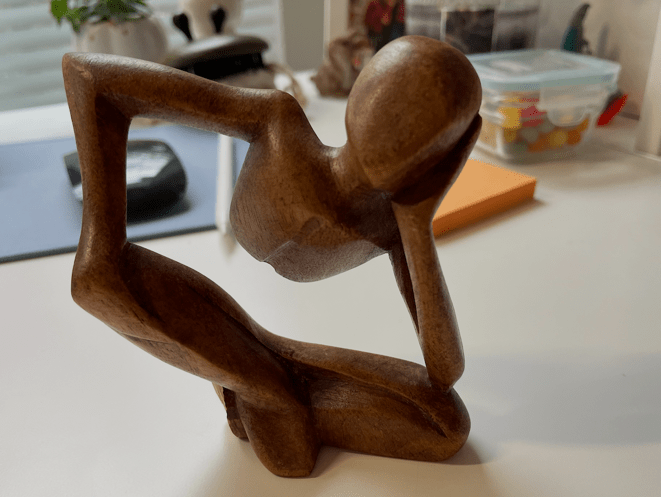
This is a small statue of a thinking man. I brought it today because this is honestly what I look like most of the time—thinking, confused, and trying to make sense of things I don’t fully understand yet.
Today, I want to introduce myself by talking about a pattern in my life: I keep entering situations I don’t understand at first—and how that pattern has shaped me.
I’ll do that by talking about my past, my present, and my future.
I was born and raised in Nanchang, Jiangxi, China, in a research-oriented family. My grandparents and my dad are doctors, and my mom is an accounting professor, so growing up, studying and researching were always part of daily life. As a kid, I didn’t think this was special—Thinking felt as normal as breathing.
When I was eighteen, I moved to Sydney, Australia. I did a liberal studies degree and took courses across eight different majors, usually three or four at the same time. I was constantly switching modes—never fully certain what I was doing, but always thinking. That feeling of not fully knowing, yet still moving forward, became very familiar to me.
My research journey really started at CSIRO Data61, Australia’s largest public research organization. I worked on a project combining game theory and differential privacy. At the time, I didn’t even know what differential privacy was, and I was the only person in the building without a computer science or engineering background. It was intimidating—people genuinely questioned why I was there. But instead of leaving, I stayed and tried to think my way through it.
That experience taught me something important: I may not understand things immediately, but I’m comfortable sitting with confusion and thinking until clarity forms. And that pattern didn’t stop there.
Right now, I’m a PhD student at the business school, working on research in decentralized finance, or DeFi. My current project studies something called pseudo-renegotiation in smart contracts—basically how people adapt when contracts are rigid but reality changes.
The funny part is that before this project, I had never touched crypto or DeFi at all. I didn’t trade, I didn’t code, and I didn’t follow the space. Once again, I started from not understanding the system at all.
What drew me in wasn’t familiarity—it was the questions. DeFi raises deep questions about trust, incentives, and human behavior. For my dissertation, I plan to build my own conceptual framework and algorithms for defining, identifying, and evaluating trust in DeFi systems. I’m interested in how trust forms when rules are written in code, and what happens when people have to rely on systems rather than institutions.
Seeing this same pattern repeat made me rethink how I view my future.
For a long time, I assumed my future was very clear: become a professor, follow the academic path, and check all the boxes. For a while, I thought clarity meant certainty.
Recently, I’ve realized that I don’t actually know exactly what form my future will take—and I’m okay with that. Especially in a fast-moving space like DeFi, there’s a much bigger world outside academia. I could be a researcher, a freelancer, an entrepreneur, or something I can’t even name yet.
What I do know is this: when life keeps pushing you into the same kind of situation over and over again, that’s probably your nature. For me, that nature is thinking—questioning, reflecting, and trying to understand complex systems. As long as I can keep doing that, I trust that I’ll be on the right path, wherever it leads.
So today I talked about my past—being pushed into unfamiliar intellectual spaces, my present—doing the same thing in DeFi, and my future—which I now see as open rather than predefined.
This statue represents me not because I always have answers, but because I’m always thinking. If I had to describe myself in one word, it would be a thinker. I think, therefore I am—and as long as I keep thinking, I trust I’ll end up where I’m meant to be.
Xinyue
Feb 2026
Houston
 I Know That I Know Nothing
Leave a comment